
The Silver Hammer That Shatters Relativity (1994)
This article presents the essay “The Silver Hammer That Shatters Relativity,” originally published in the 1994 collaborative volume Relativity Is Still Wrong. The central message is simple: you don’t need to be a physicist to examine the foundations of relativity. Once the prestige surrounding the theory is set aside, its mathematical tricks and logical flaws become clear enough for anyone to verify. My hope is that as many readers as possible will take part in this examination for themselves.
- What Is the Silver Hammer?
- The Greatest Discovery of the 20th Century
- Still Relativity?
- The Trick of Functional Expressions
- Simultaneous Events
- A Changing Ruler
- The Formula for Velocity
- The Law of Constant Turtle Speed
- Toward the Final Answer
- About the Michelson–Morley Experiment
- Can Commercialized Physics Make a Courageous Retreat?
What Is the Silver Hammer?
In the early 20th century, a brilliant mind presented an enormous puzzle that greatly influenced astrophysics with revolutionary predictions such as the Big Bang and black holes. This puzzle, which has no definitive solution, is known as the theory of relativity. While praised by many scholars, discrepancies between observation and theory have become increasingly serious even into the 1990s. Is the theory of relativity—still being tested with extremely expensive equipment—truly worth verifying?
I myself have never doubted the theory of relativity. I simply could not understand it at all. Why does it use incorrect equations? Why are even physicists deceived by mathematical tricks that an elementary school student could recognize? One reason is that people unconsciously decide the form of certain functions based on habit or assumptions. However, it seems extremely difficult to get others to acknowledge this fact.
Let me briefly explain this functional trick. In mathematics, we often omit functions that simply multiply by one. When developing a completely new theory, if such a function needs modification, it should be explicitly written in the equation. But if one is unaware of its existence, the function remains hidden as ×1 within the formula, distorting the entire equation. As a result, a strange theory emerges—one that defies common sense. The theory of relativity is a prime example of a theory built using several such tricks.
If a previously overlooked function is discovered after a theory has been constructed, the theory collapses instantly. Here, I refer to such functions—those that threaten the integrity of a theory—as “Silver Hammers.” For over 90 years, we have focused on verifying and extending the visible equations of relativity, captivated by its sophisticated formulas. Meanwhile, the Silver Hammer has been waiting for its chance to strike. And now, that decisive blow is about to fall.
When you witness the so‑called greatest pseudoscience of the 20th century—the theory of relativity—being shattered with surprising ease, will you still seek the laws of nature within it? Or will you abandon the theory altogether?
This essay introduces several forms of the “Silver Hammer.” First,
- 1. I will explain why the historic equation E = Mc2 does not hold the significance commonly attributed to it.
- 2. I will show that special relativity is a mathematical trick that relies on omitted functions.
- 3. Finally, I will briefly explain how the Michelson–Morley experiment, which is said to support relativity, actually supports classical physics.
The Greatest Discovery of the 20th Century
E = Mc2
There is probably no other equation as famous or as shocking to the public as this one. It has even been said that the revolutionary discovery—“a small amount of mass is equivalent to an enormous amount of energy”—would instantly solve all conventional energy problems. Since the equation was accepted by the physics community, many researchers and vast amounts of funding have been devoted to exploring its practical applications. However, I believe that no physical phenomenon in this world actually follows E = Mc2.
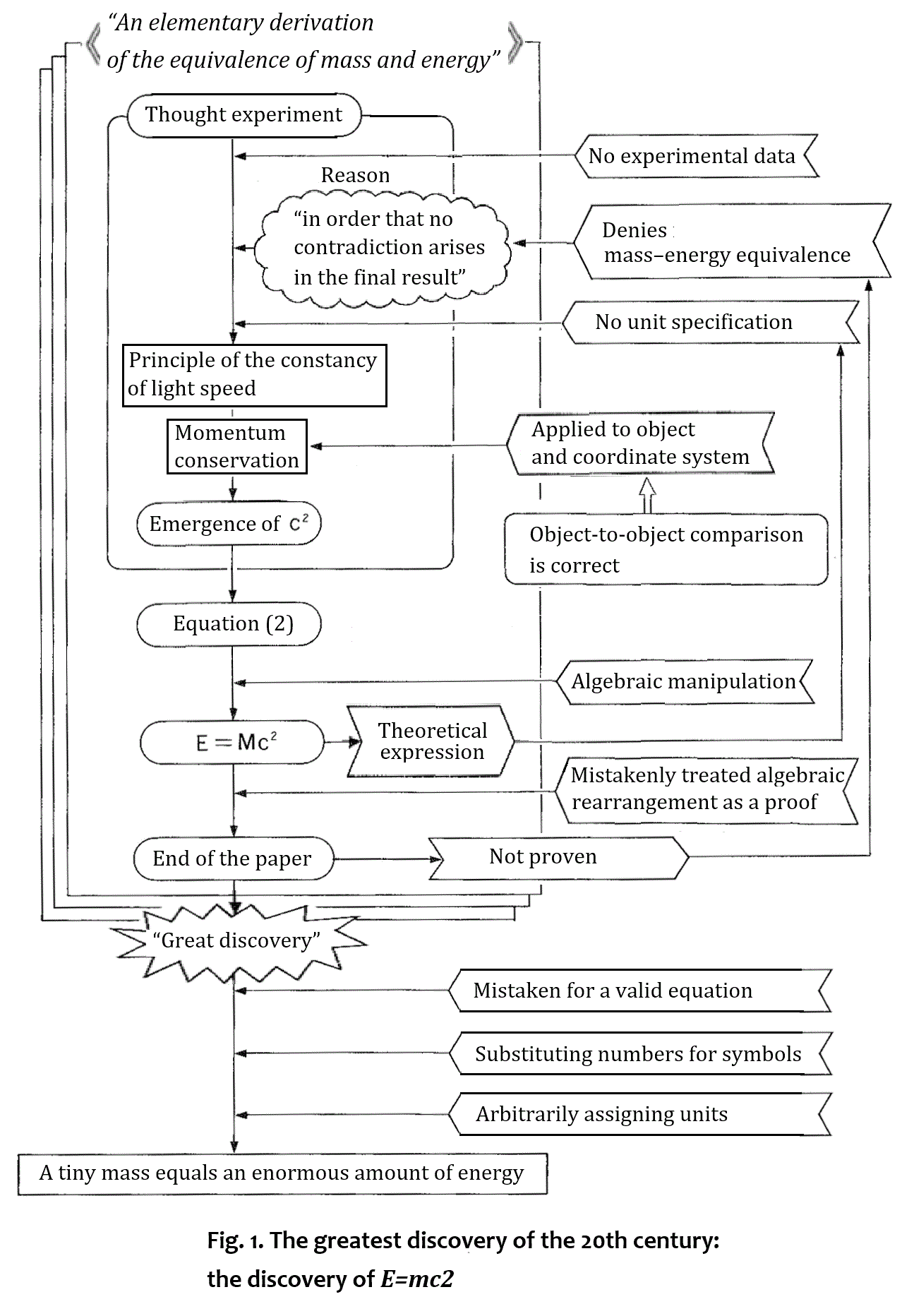
The short paper “An Elementary Proof of the Equivalence of Mass and Energy,” published not in 1905 but in 1946, derives E = Mc2 using only a thought experiment, without relying on any experimental data regarding mass or energy (see Appendix 2). Common sense tells us that one cannot derive a relationship without examining data. No matter how much of a genius one may be, it is impossible to prove truth from pure imagination. It is far more natural to assume that some kind of trick was used. Whether E = Mc2 is the greatest equation of the 20th century or merely a clever trick becomes clear to anyone who reads the paper carefully. Let us begin by examining it.
The Basis of the Assumption
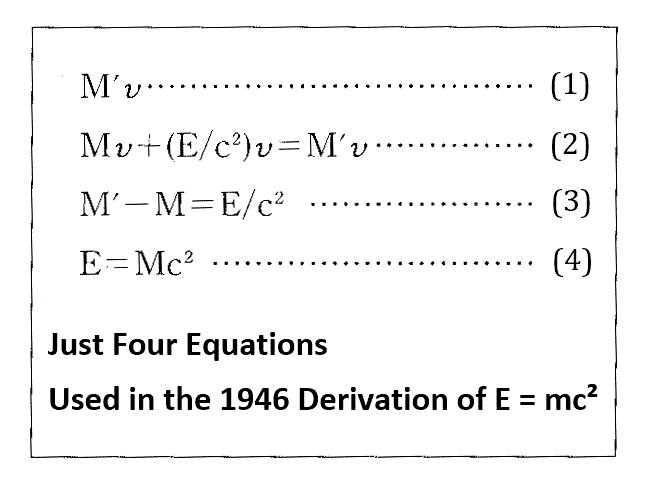
The paper contains only four equations, which appear on the next page. It is astonishing to think that the course of human history was influenced by these four equations alone. Now, please focus on equation (2). Let us confirm that rewriting this equation yields E = Mc2.
- Divide both sides by υ:
M + (E / c2) = M´ - Move M to the other side:
E / c2 = M1 = M´ − M - If we define M´ − M as M1, then:
E / c2 = M1 - Solving for E gives E = M1c2, or more generally:
E = Mc2
The latter half of the paper is devoted to such manipulations of equation (2). Since there is no new discussion about mass or energy in this sequence of steps, it becomes clear that the equivalence of mass and energy was already embedded in equation (2). The equation itself is derived from the results of a thought experiment described earlier in the paper, and it carries the following meaning:
“The momentum of an object, Mυ, becomes equal to the momentum of the radiation complex S and S´, which is (E = Mc2)υ.”
Where did this result of the thought experiment come from? A discovery of such historical importance should be supported by careful observation and experimentation. Yet the paper contains no such data. In fact, this result was assumed precisely because no experimental data existed. The assumption is: “After energy E is absorbed by mass M, the mass increases to M´.” In other words, equation (2) is the first equation to describe the equivalence of mass and energy. The paper ends immediately after deriving E = Mc2.
The proof is completed simply by transforming an assumed equation. Assuming the equivalence of mass and energy and then deriving E = Mc2 does not constitute a proof of that equivalence. If one assumes that a baby bird is a puppy, one could eventually prove that dogs can fly—but unless one proves that the baby bird is indeed a puppy, the conclusion is nothing more than an assumption. Likewise, E = Mc2 is not a conclusion derived from an established theory, but merely a theoretical expression summarizing the assumed conditions. As evidence, the paper explicitly states that the assumption is “in order that no contradiction arises in the final result.”
In the end, the “equivalence of mass and energy” was assumed solely to make E = Mc2 hold true; it was never proven. This method—transforming assumptions and presenting them as proof—is also used in the paper on special relativity, and unless one reads carefully, one may be easily convinced. Using this method, even traveling to the moon by dog sled might be “proven” possible.
The Pitfall of Theoretical Equations
Many scientists were astonished by this equation because of the c2 attached to mass M. Substituting a huge value for c2, they concluded that “enormous energy can be extracted from a tiny amount of matter,” dreaming that a single potato could solve the world’s energy crisis. The military balance of nations would be determined by pumpkins and carrots, and even cow dung could become a threat to enemy countries.
E = Mc2 is merely a theoretical expression describing the assumed physical meaning. Since it contains no quantitative elements, it cannot be used with units or numerical values. Doing so would exceed the scope of the equation. No one would arbitrarily insert units and numbers into Ohm’s law (I = V/R). The same applies to E = Mc2; it should not be treated like a numerical formula. Nowhere in the paper are units or quantities defined. The fact that the “energy equivalent to mass” changes depending on the choice of units shows that this equation contains no quantitative elements whatsoever.
Even if we treat it as a numerical equation, there is a major misunderstanding in the common interpretation. Consider the following equation:
$1 = ¥100
This expresses that one dollar equals one hundred yen. Here, $ and ¥ are units (functions). From everyday experience, we know that yen is the smaller unit because it requires 100 times more to equal one dollar. If E = Mc2 is treated as a numerical equation, then E is a unit c2 times larger than M. Keeping this in mind, the meaning of E = Mc2 becomes:
“If we assume the equivalence of mass unit M and energy unit E, which is c2 times larger, then E = Mc2 follows.”
How obvious this is. Just as assuming that yen and dollars can be exchanged does not tell us the exchange rate, assuming the equivalence of mass and energy cannot reveal their ratio. No matter how many times M is multiplied, both sides remain equal, so only the units change. All variation in the equation is absorbed into the change of units. This problem arises because the paper never defines units; had the units been expressed as functions until determined, such confusion would not have occurred. The assumption that units are fixed has contributed to the widespread belief that E = Mc2 is a monumental discovery.
Still Relativity?
In 1905, the paper “On the Electrodynamics of Moving Bodies” was published. It is the famous paper that introduced the theory of relativity, which later became the foundation of modern physics and cosmology (see Appendix 3). The theory of relativity has confused 20th‑century physics and is still supported by many physicists today. Everything began with this paper. Could there really be errors in a theory that has supposedly been examined thoroughly for 90 years by so many brilliant minds? A strong hint lies in the surprising fact that the author of this theory struggled with arithmetic and fell behind in elementary school. If there is an error, it is more likely to be found in the elementary equations rather than the advanced ones. Focusing on the initial assumptions of the paper is the first step toward the answer.
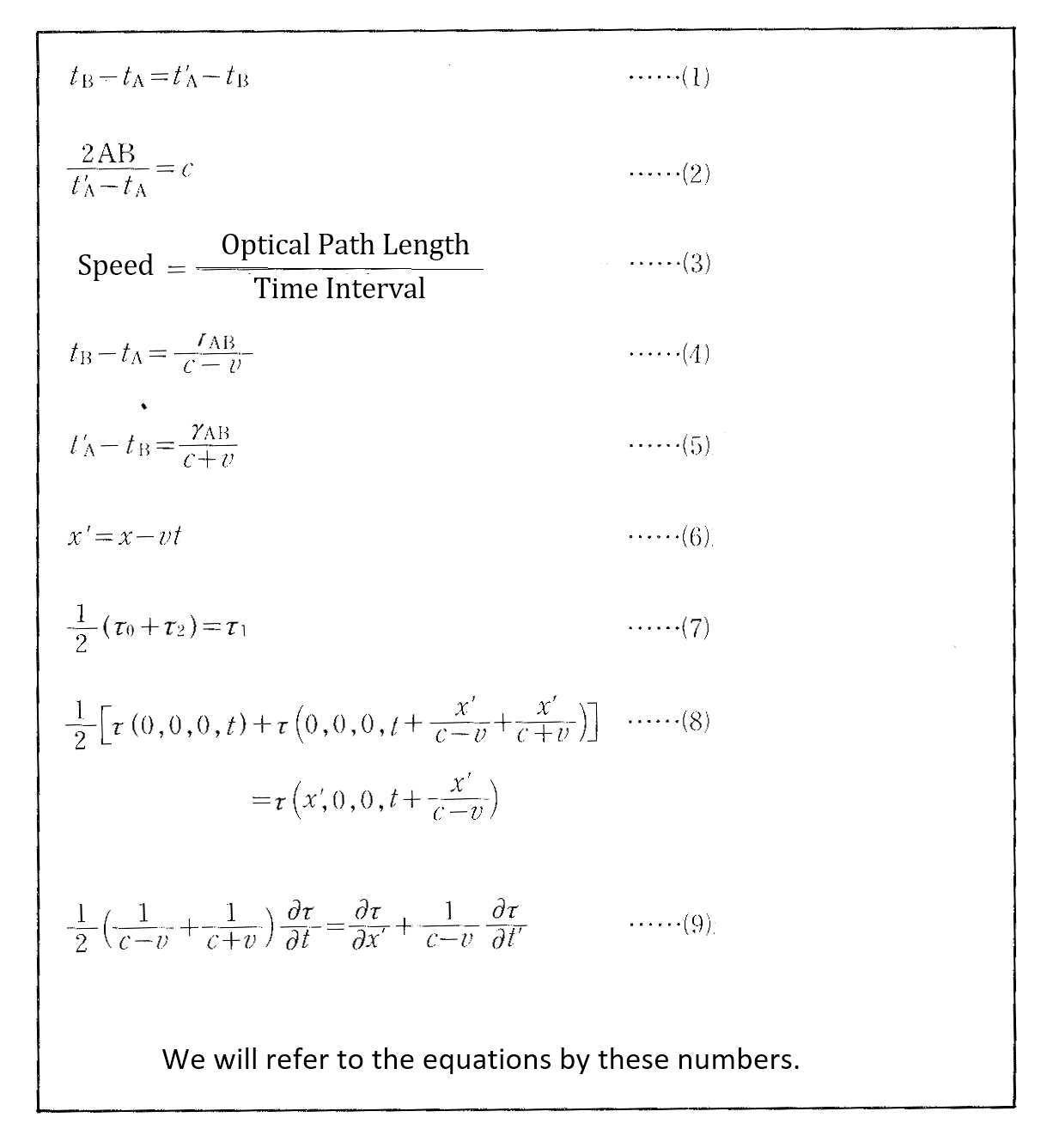
The paper contains about 200 algebraic expressions, but here we will examine only the first nine. These elementary equations are simple enough to understand with basic arithmetic, yet they contain several errors that determine the nature of the entire theory. The equations that follow are too complex to be useful for judging the validity of the theory. To verify relativity, you do not need massive experimental facilities costing enormous sums of money—just a single sheet of paper and a pencil.
The Trick of Functional Expressions
First, let me explain a simple trick involving functions. Normally, a function is written as f = a(x). In this case, the function f multiplies the data x by a. With this notation, x is placed inside parentheses so that it cannot be combined with other numbers unless it is transformed by the function f. This is a basic rule—and habit—of mathematics. If we simply treat f as a linear function that multiplies the given data by a, then we may treat it similarly to a multiplier. And if it is a multiplier, then data with the same function symbol attached can be combined without issue.
Now look at equation (8). τ is defined as a function of x′, y, z, and t, so τ is undeniably a function (and the purpose of the paper is to determine this unknown function τ). Equation (8) contains three sets of parentheses, each holding data for the function τ. Equation (9) is obtained by taking x′ in equation (8) to be infinitesimal and rewriting the expression accordingly. However, in equation (9), the parentheses for the function τ have disappeared. The parentheses on the left side are not for function input but merely indicate the order of calculation. In other words, equation (9) contains no parentheses for function arguments at all. The parentheses were removed because the data from equation (8) were “calculated.”
Doesn’t that seem strange? The paper is supposed to be working toward determining the unknown function τ. Its structure is not revealed until equation (51), far beyond equation (8). There is no way the parentheses could be removed in equation (9), where τ is still unknown. This would only be possible if τ were a linear function like a multiplier—but if τ were linear, relativity would collapse back into classical physics.
What happened here is that the author either “mistook the parentheses for a function with parentheses used for multiplication and calculated the inside,” or “solved for the unknown function τ using a method appropriate only for linear functions.” If you look at a bank map while searching for buried treasure, you will certainly “find” treasure. The reason τ could be determined without any formula for unknown functions is that the wrong method was used. This explains why there is no need to examine the advanced equations beyond (9).
Simultaneous Events
“A light ray is emitted from the origin of the moving system κ along the X‑axis to x′ at time τ1, reflected there, and returns to the origin at time τ2.” Equation (7) expresses this under the assumption of the constancy of the speed of light.
The left side represents the round‑trip time, and the right side represents the outbound time. The factor 1/2 at the beginning indicates that the outbound and return trips took the same amount of time in the moving system. Describing the same event from the stationary system yields equation (8). Again, the left side is the round‑trip time, the right side is the outbound time, and again the factor 1/2 appears. Thus, equation (8) also asserts that the outbound and return trips took the same amount of time. The fact that the two equations have the same form indicates that the events occurred simultaneously. Since the same event is being viewed from different coordinate systems, should we interpret the events in the stationary and moving systems as simultaneous, as common sense would suggest?
However, the paper argues that under the condition of constant light speed, the concept of simultaneity does not hold. It claims that the same event is not simultaneous in different coordinate systems. If this claim is adopted, equations (7) and (8) cannot represent simultaneous events. Just as it takes longer to chase a fleeing thief than to meet one head‑on, light traveling along a moving segment would take longer on the outbound trip than on the return trip, contradicting the moving‑system description. Thus, in the stationary system, the factor 1/2 should not appear; it should be replaced by an unknown function. The 1/2 in equation (8) is a remnant of inadvertently applying the concept of simultaneity during the coordinate transformation. Without this concept, the transformation method would not yet exist, and the derivation could not proceed further.
A Changing Ruler
Consider the following setup: “A light ray leaves point A of a moving rod AB at time tA, is reflected at point B at time t′A, and returns to A at time t.”
Under the principle of constant light speed, an observer moving with the rod claims that the outbound and return trips take the same amount of time. An observer in the stationary system claims that the outbound trip follows equation (4) and the return trip follows equation (5). Thus, the round‑trip times differ. These two equations are used to deny the classical concept of simultaneity, but in fact, the constancy of light speed and the Galilean transformation are unrelated. Using (c − υ) or (c + υ) to compute relative light speed under a Galilean transformation naturally breaks simultaneity; there is nothing mysterious about it.
If the speed of light is constant in all coordinate systems, then it is a constant. But if one computes relative light speed using (c − υ) or (c + υ), then light speed becomes a variable. (Which one does relativity use?) Although the paper treats light as something special, it mixes it with other quantities during the derivation. This equates a constant with a variable and creates a paradox. Some argue that “relativity is a correction to classical physics, so this is acceptable,” but τ is a transformation function from the moving system to the stationary system—not from classical physics to relativity. Moreover, the claim that “classical physics is an approximation” only highlights the mathematical flaws of a theory that uses approximations to obtain its results.
Now let us examine the measurement of the length of a moving rod using light, based on equations (4) and (5). Can something that appears constant to all observers serve as a reliable measuring tool? Suppose observer A moves along with a running snake and measures it with a 10‑meter ruler. A first reads the scale at the snake’s head, and one second later reads the scale at the tail, allowing the length to be calculated.
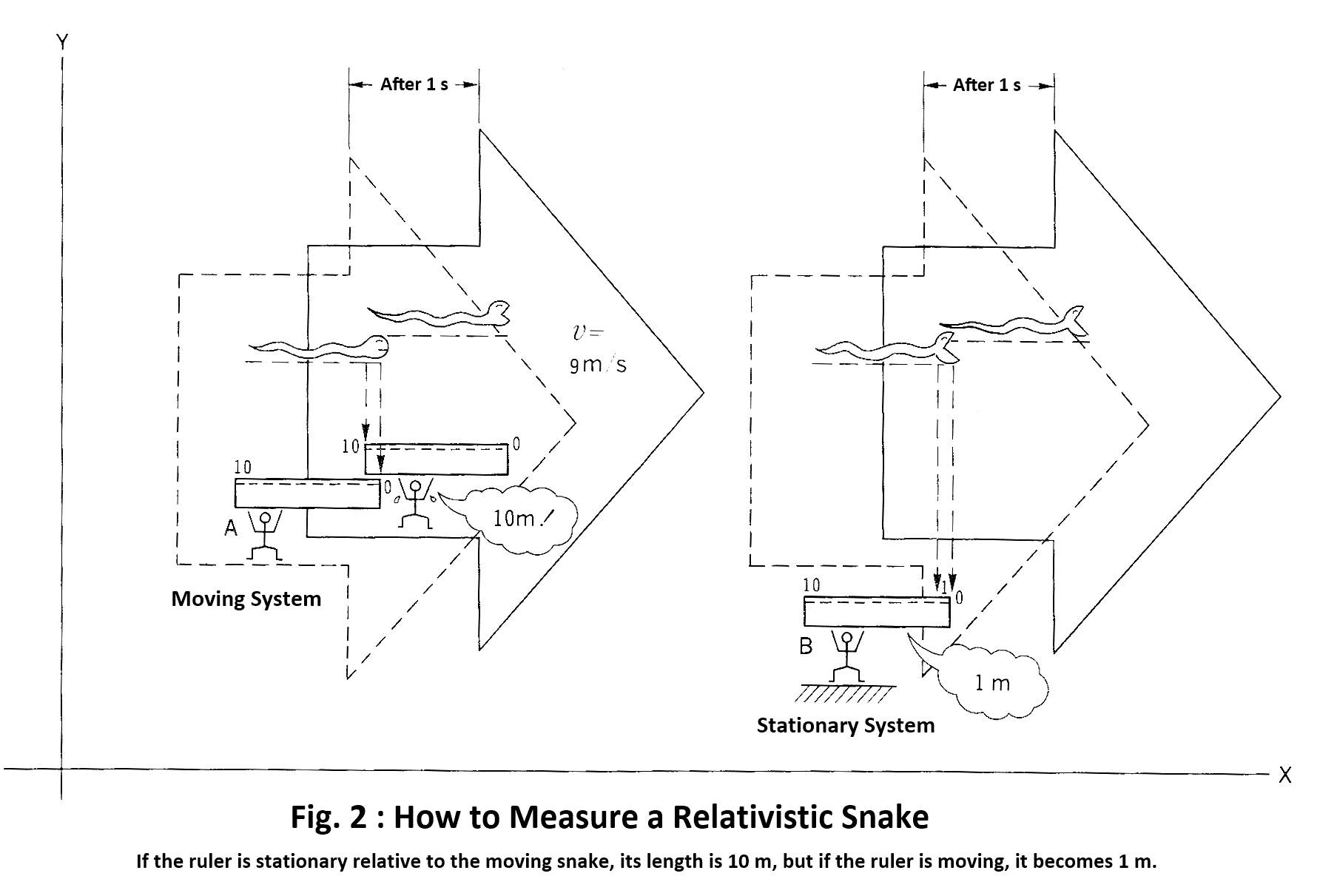
From A’s perspective, the relative speed between the snake and the ruler is zero. After completing the measurement, A declares that the snake is exactly 10 meters long and runs away. Hearing this, observer B in the stationary system picks up a fallen ruler and measures the running snake. From B’s perspective, the relative speed between the snake and the ruler is 9 meters per second. During the one second between reading the head and tail scales, the snake’s tail moves 9 meters toward the ruler’s end. Thus, B claims the snake is 1 meter long. Even though both observers used the same ruler to measure the same snake, the results differ. This phenomenon, similar to relativity, occurs simply because “the reference and the object being measured are moving.” The measurement method is flawed. A ruler that appears constant to A and B is meaningless unless it is also constant to the snake. Naturally, the longer the measurement takes, the greater the error.
Relativity replaces the time‑consuming measurement with light speed as the reference. Since both the measuring tool (light) and the object move, the earlier conditions can be satisfied simultaneously. The theory insists on measuring everything with light because this trick is necessary. Even after hearing this explanation, observer B—now swallowed by the snake—would surely rejoice: “A 2‑meter‑tall guy like me fitting inside a 1‑meter snake must be a relativistic effect!”
The Formula for Velocity
To treat space mathematically, we define orthogonal axes x, y, and z. Thus, three pieces of data are required to describe a point in space. If even one is missing, the point cannot be uniquely determined, and numerical calculations cannot be performed. Nor can any single component be treated independently, because they must be combined through a transformation based on the Pythagorean theorem before being regarded as a single value.
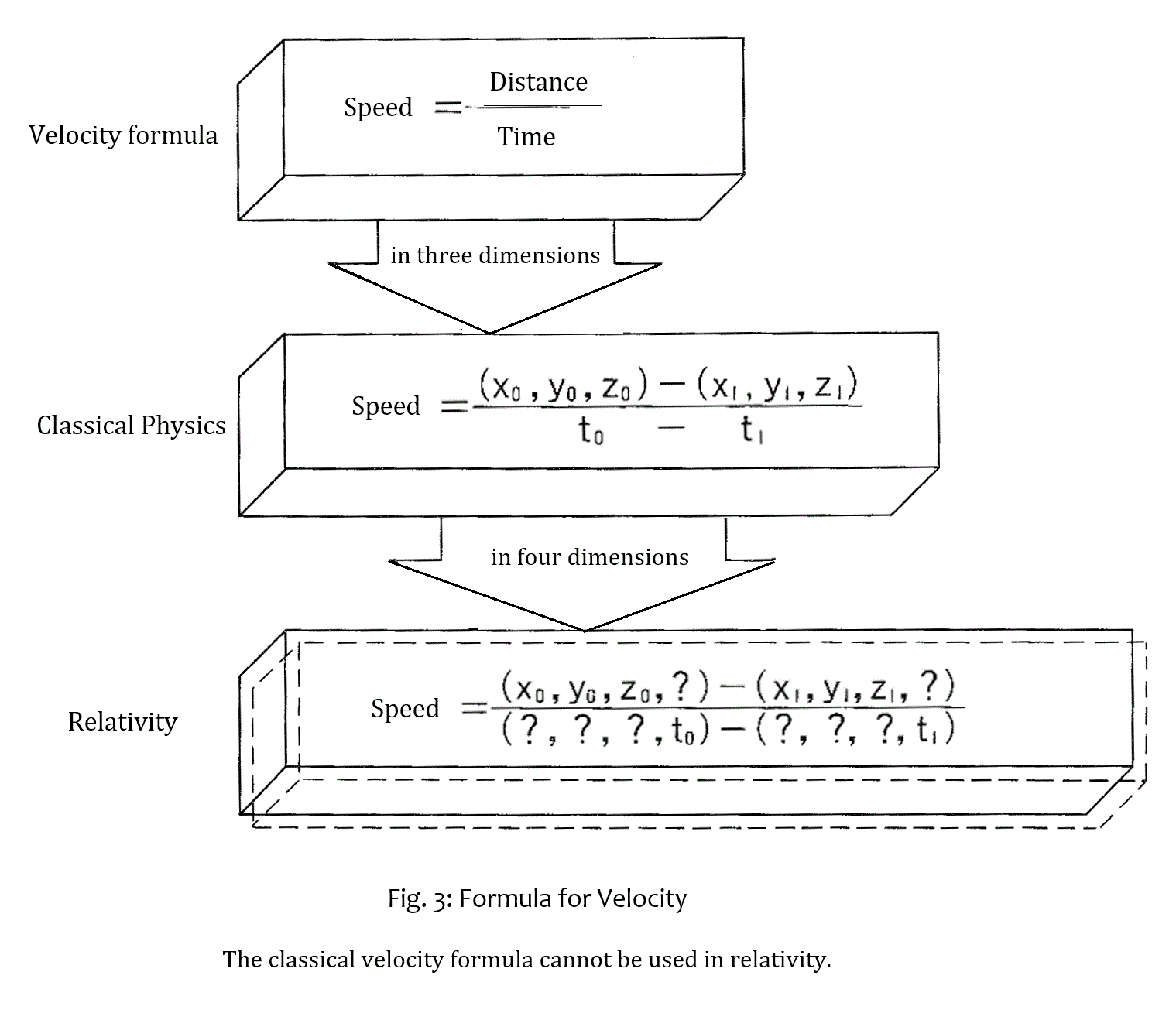
How does relativity handle this? It adds the time component t to the three spatial components, forming a four‑element set to represent a single point. This is why the function τ in equation (8) contains four components (x, y, z, t). If time and distance are calculated separately in this theory, the result is a distorted equation, because untransformed or incomplete coordinate values are being substituted directly as distances. Yet the theory treats time, velocity, and distance as independent parameters. Distance is determined by x, y, and z; time is determined solely by t.
Look at equation (3). The absence of the velocity υ indicates that this relation applies only to light in the stationary system. A transformation valid for all coordinates has not yet been found. If equation (3) is used in place of the unknown transformation function, it effectively omits the transformation from the stationary system to the moving system. Relativity cannot be constructed without overlooking a function somewhere. Using equation (3) as the velocity formula in the time component of equation (8) is one such example.
The Law of Constant Turtle Speed
Suppose we assume that a certain special turtle walks at a constant speed, regardless of who observes it. Call this the “Law of Constant Turtle Speed.” Would you conclude that all physical laws must be revised to conform to the turtle? Or would you conclude that the turtle simply has its own special rule that does not affect anything else? In everyday life, we do not pay attention to turtles, so we would choose the latter. But when the turtle is replaced by light, people choose the former. For relativity to hold, one must adopt the same reasoning as concluding that turtles govern the laws of physics.
The “principle of constant light speed” does not require modifying physical laws unrelated to light. Therefore, there is no need to distort time or space to keep light speed constant. Indeed, if we treat light as special, the requirement of constant light speed is easily satisfied. For example, if we adopt light‑seconds as the unit of speed:
c = 1
It seems too simple, but this alone satisfies the principle. However, this expression must be kept completely separate from other equations, because its mathematical form differs. Alternatively, we may write:
f(c)
to ensure that c cannot be combined with any other value. This alone satisfies the principle of constant light speed. Yet the paper does not use functional notation for c and instead substitutes it directly into the Galilean transformation. This is done to distort time and justify the need for a new theory—relativity.

Toward the Final Answer
Since just before the birth of relativity, f(c) has been used frequently. For a long time, it has supported relativity unnoticed. It is time to shine a spotlight on this unsung hero. The reason people fail to notice the mathematical errors in relativity lies in the hiding place of this function.
Now, based on the principle of constant light speed, answer the following questions. Assume that light speed is c in all coordinate systems.
- (1) What is the speed of light for an observer at rest (speed 0)?
- (2) What is the speed of light for an observer moving at speed 1?
- (3) What is the speed of light for an observer moving at speed υ?
- (4) What is the speed of light for an observer moving at speed c?
Under the principle of constant light speed, all answers are c. And you? Did you also answer c regardless of the observer’s speed? What happened to the data 0, 1, υ, and c? Did you ignore them all?
If one intends to describe a new law of motion, one must clearly distinguish it from the Galilean transformation and accurately describe every mathematical step, even if it is simple enough to do mentally. In the Galilean transformation, the observer’s speed υ is not discarded, but under the principle of constant light speed, it is.
If we consider that f(c) is a function that discards the observer’s speed υ and retains only c, then υ must be included in the data:
f(c, υ)
This is the more accurate notation. Only then is it possible to “make light speed c regardless of the observer’s speed.” However, relativity contains no such function. It cannot allow such a function to appear.
The function f(c, υ) carries a mathematical flaw that forms the core of relativity. Answer the questions again. When you answered the light speed under the principle of constant light speed, did you do the calculation mentally?
Anyone who “understands” relativity certainly did. When told that light speed transforms under the Galilean transformation, they would write the equation. But when told that light speed is constant for all observers, they instinctively perform mental arithmetic and answer c.
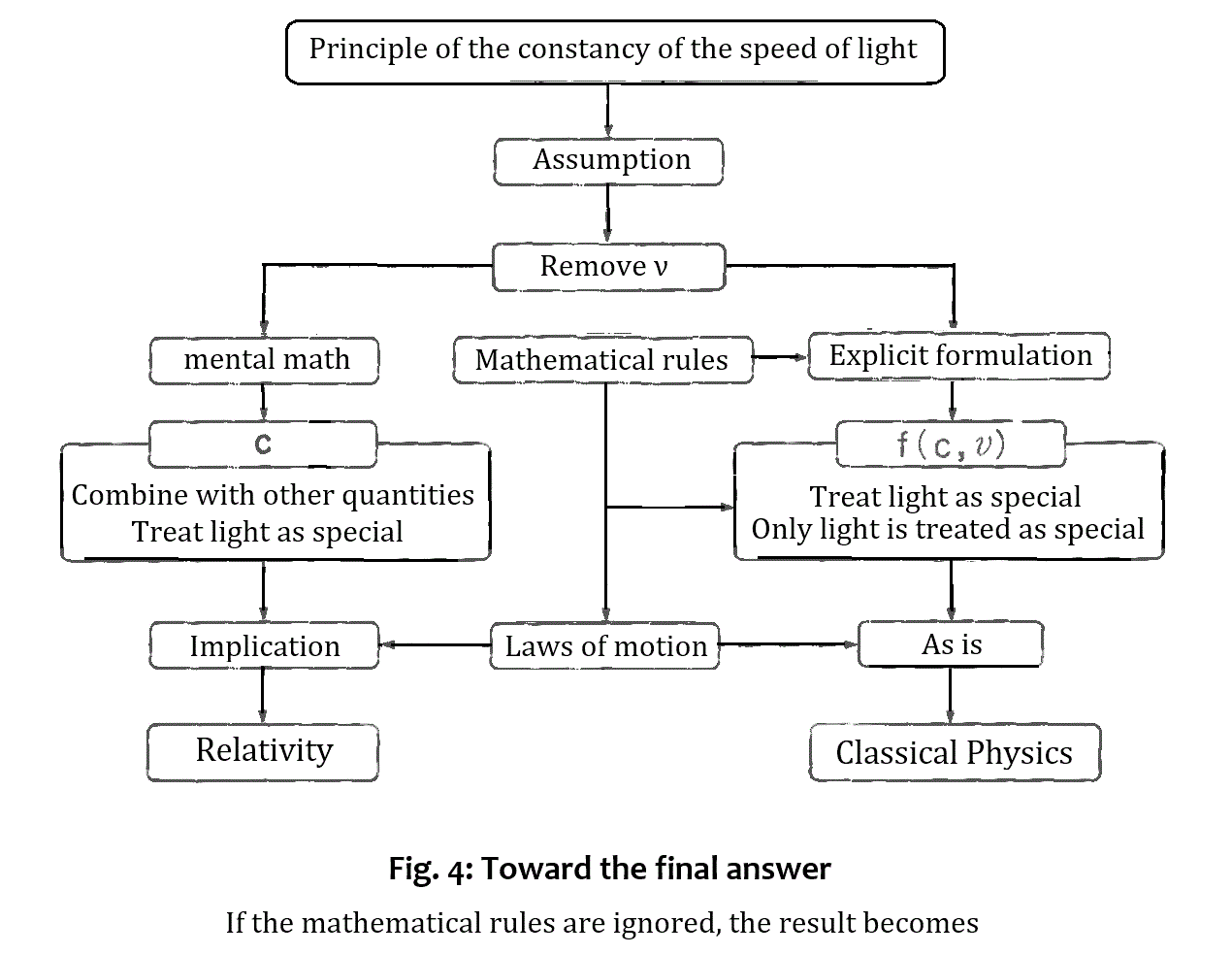
This mental arithmetic is the greatest “Silver Hammer” that has supported this imaginary theory for 90 years. The trick that makes discovery impossible was hidden in the basic assumptions that everyone accepted without question. To understand relativity, one must first fall for this trick. The long‑standing confusion surrounding relativity can be explained in a single sentence:
“The function used in the mental arithmetic is not written down.”
The forgotten function f(c, υ) inevitably destroys relativity. Before the equations can even be expanded, the very basis of the theory collapses. Had this been noticed earlier, the enormous effort spent throughout the 20th century would not have been wasted.
Some may argue that my claim merely misunderstands the physicists’ habit of omitting parentheses and units in functional notation. But if such shorthand—used as a hidden professional technique—creates serious errors, then it is indeed a problem. I am simply pointing that out. For reference, Einstein’s paper is included in full at the end of this document.
About the Michelson–Morley Experiment
Even when one explains that the theory of relativity is incorrect, a common rebuttal is that “relativity has been proven by experiment,” and one of the experiments cited is the Michelson–Morley experiment. This experiment was conducted in 1887, before the publication of the theory of relativity, and it is frequently referenced as an ideal example for highlighting contradictions in classical physics and the supposed necessity of the constancy of the speed of light.
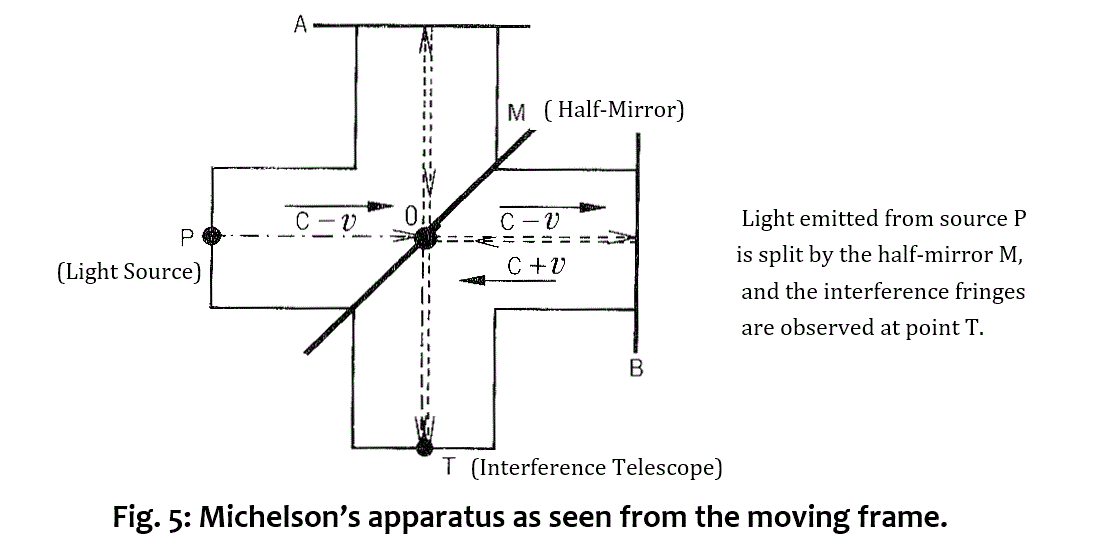
The apparatus separated light from a single source into two paths using a half‑mirror, then recombined them at a single point after several reflections (Figure 5). The entire device was rotated in order to detect differences in optical path length by observing changes in the interference fringes.
If the speed of light were not constant, the experiment should have detected changes caused by the Earth’s orbital motion. However, the observations showed no change in the interference fringes of the two light beams. This result is still regarded as experimental proof of the constancy of the speed of light.
No matter how much one tries to demonstrate errors in relativity, many believe that the principle of constant light speed has already been experimentally confirmed. However, a careful re‑examination of the experiment reveals that the apparatus itself hides results that are completely opposite to the commonly accepted conclusion. In other words, the theory of relativity had already been disproven more than a century ago.
The Constancy of Light Speed
Was Already Refuted
Let us first examine the principle of constant light speed using this apparatus. Traditionally, this verification has been performed only from the moving system (the frame of the observer on Earth), but from the stationary system, interference fringes should appear at point T. This is because relativity denies the concept of simultaneity. At this point alone, the principle of constant light speed becomes contradictory, but let us take a different approach.
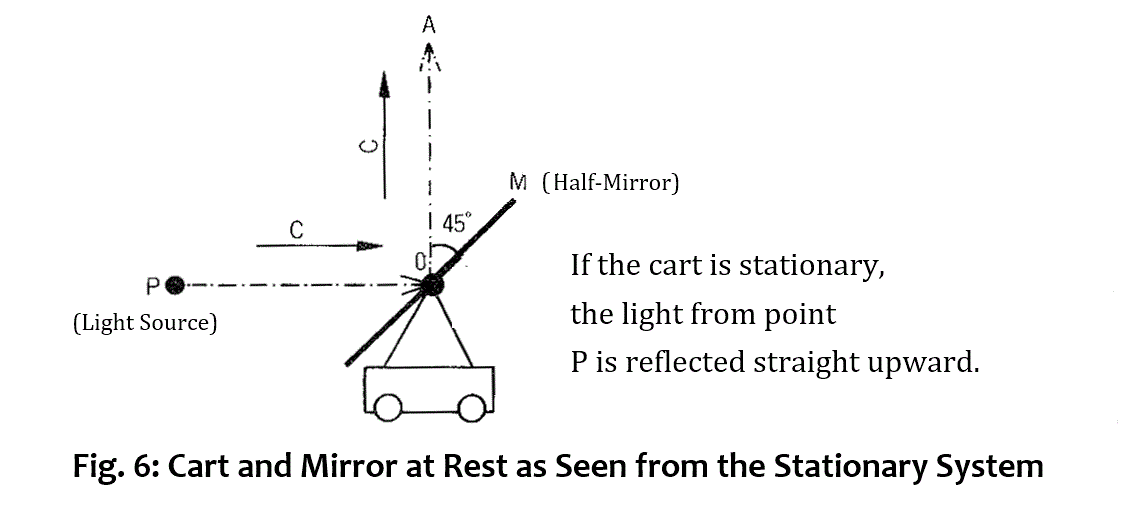
Consider a cart equipped with a mirror as shown in Figure 6. Light enters from the left side of the page, strikes the mirror at a 45‑degree angle, and is reflected upward. If the cart is stationary, ∠POA is 90 degrees. If the cart and observer are moving along the x‑axis at speed υ, ∠POA′ will appear smaller than 90 degrees (Figure 7).
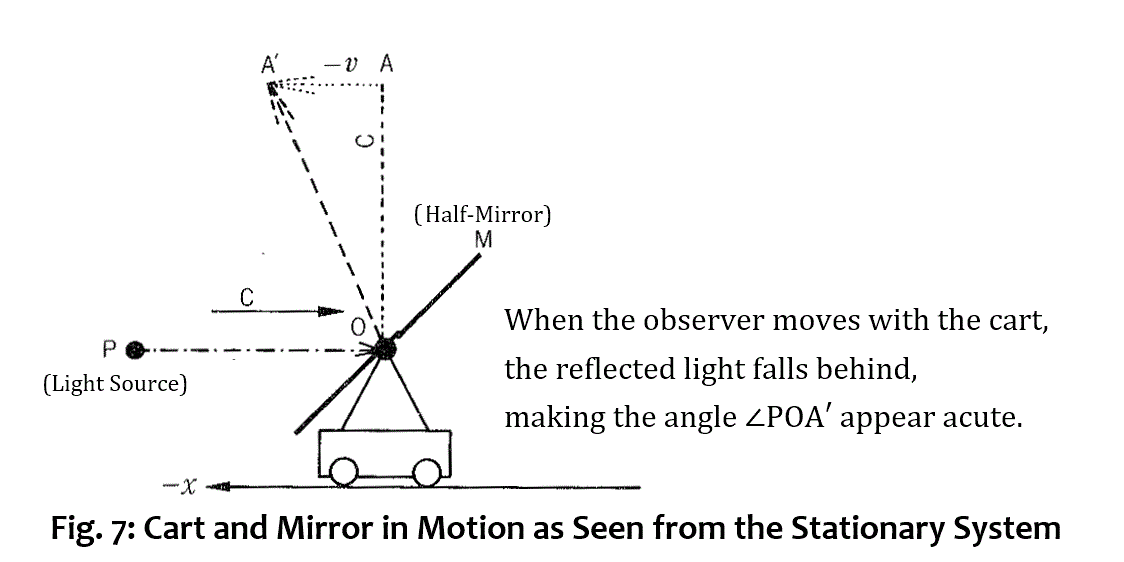
According to the principle of constant light speed, segment OA′ must be the same length as segment OA. Therefore, the mirror must be adjusted so that the two segments become equal (Figure 8).
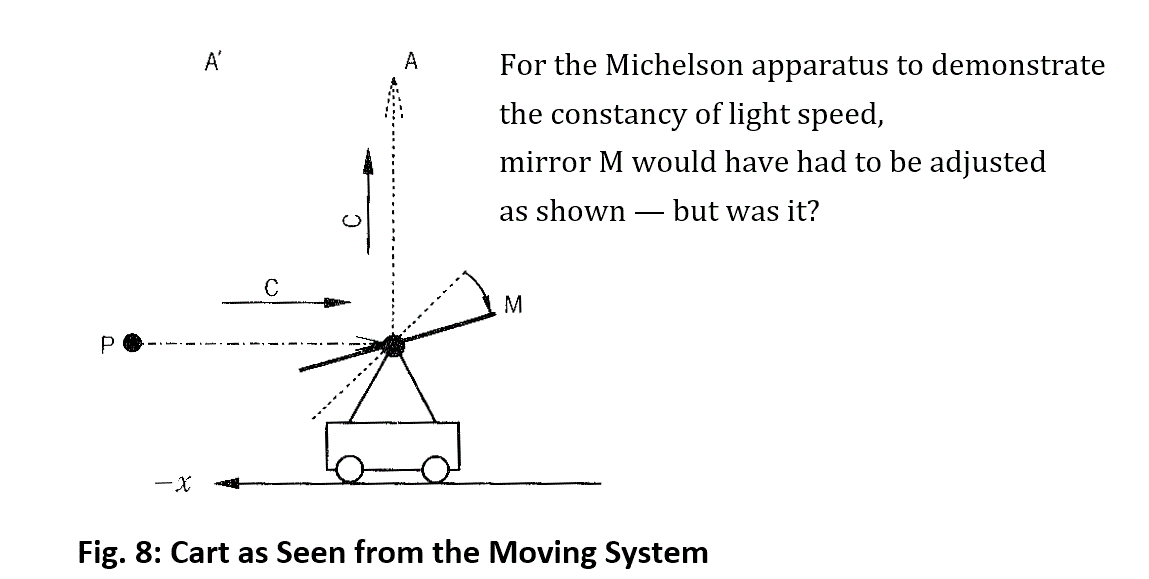
Was the half‑mirror M in the Michelson–Morley apparatus adjusted in this way? If no change was observed regardless of the orientation of the apparatus, then M must have maintained a precise 45‑degree angle relative to the light. Otherwise, beams A and B would not remain parallel, and the interference fringes at point T would change. This means that OA′ and OA were not the same length. Thus, the hypothesis of constant light speed was already refuted by the Michelson–Morley experiment itself.
Strange Light
It is true that the Michelson–Morley experiment contradicts classical physics. However, the light used in the verification behaves in a way completely different from classical light. It is important to understand this strange light first.
[Thought Experiment 1]
Observer A is riding a train moving at 100 km/h. Outside the train, a sturdy wall is installed where A can see it, allowing A to observe the moment when an object overtaking the train collides with the wall (Figure 9).
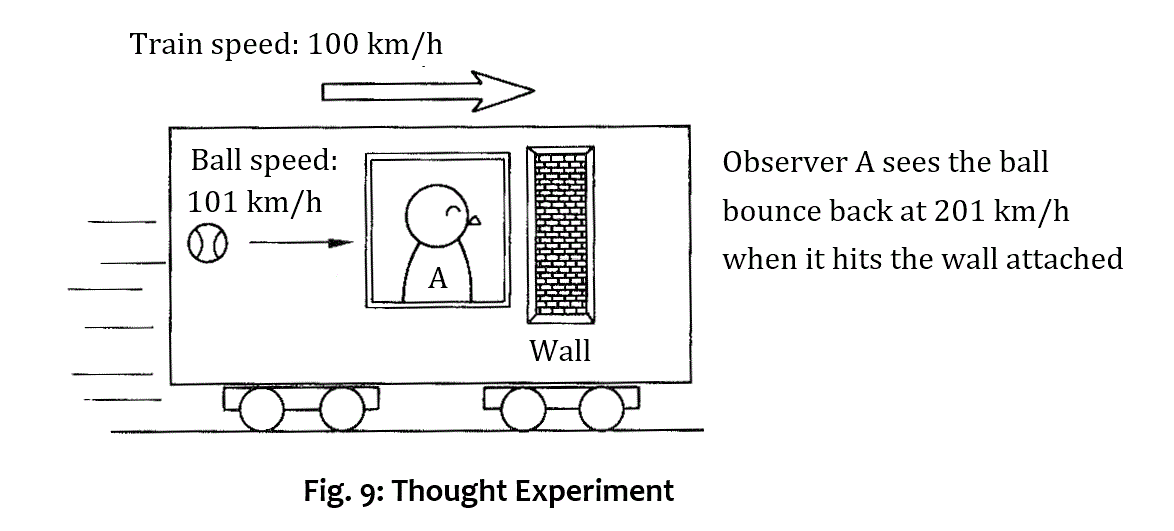
Now, a perfectly elastic ball moving at 101 km/h overtakes the train and strikes the wall. What does observer A see? Air resistance and gravity are ignored.
Consideration 1
-
The ball hits the wall at 1 km/h and bounces back at 1 km/h.
- Calculations:
- 101 − 100 = 1
- 100 − 101 = −1
Consideration 2
-
The ball hits the wall at 1 km/h and bounces back at 201 km/h.
- Calculations:
- 101 − 100 = 1
- 101 + 100 = 201
Consideration 1 is easy to imagine, but Consideration 2 is highly unrealistic. A ball moving at 1 km/h suddenly accelerates to 201 km/h after impact. If such a phenomenon occurred in reality, bringing a ball onto a train would be prohibited. Even brushing against the front of the train would launch you toward the back. Riding the train would be life‑threatening.
Yet in the Michelson–Morley experiment, the verification of classical physics uses the formula from Consideration 2. Light striking a mirror at (c − υ) is treated as accelerating to (c + υ), and from the stationary system, the light is seen as traveling at speed c both before and after reflection. Light reflected from a receding mirror does not even exhibit a Doppler effect. This is not classical light at all—it is “light designed specifically to refute classical physics.”
According to classical physics, an observer in motion should see light traveling at (c − υ) reflect and return at (−c + υ).
Verification Using Classical Physics
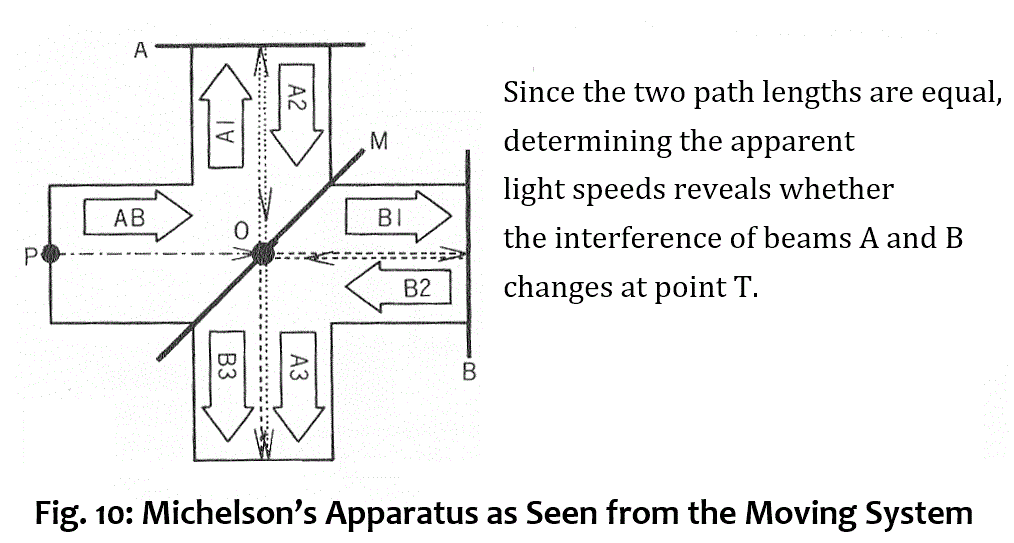
Now let us explain the Michelson–Morley experiment using classical physics. Figure 10 is a simplified diagram of the apparatus. The speeds of beams A and B are currently unknown. We will solve the problem by determining each speed one by one.
From earlier results, AB and B1 contain (c − υ), and B2 contains (−c + υ). For consistency, we rewrite B2 as (c − υ). Returning to Figure 6, let us consider the speed of beam A. The cart is moving at speed υ. When a ball strikes a wall that is moving away, its speed decreases. Therefore, an observer in the stationary system will see the speed of light decrease after reflection.
Since mirror M is at 45 degrees, moving υ in the x‑direction also means moving υ in the y‑direction. It is better to analyze the x and y components separately. Adjusting Figure 6 accordingly gives Figure 11. Applying this to the Michelson–Morley apparatus as seen from the moving system yields Figure 12. In both diagrams, speed is represented by line length. From these diagrams, we see that A1 is (c − υ). Because mirror a does not change the y‑component, the light remains at (c − υ) after reflection and reaches point T. Thus, A2 and A3 also have speed (c − υ).
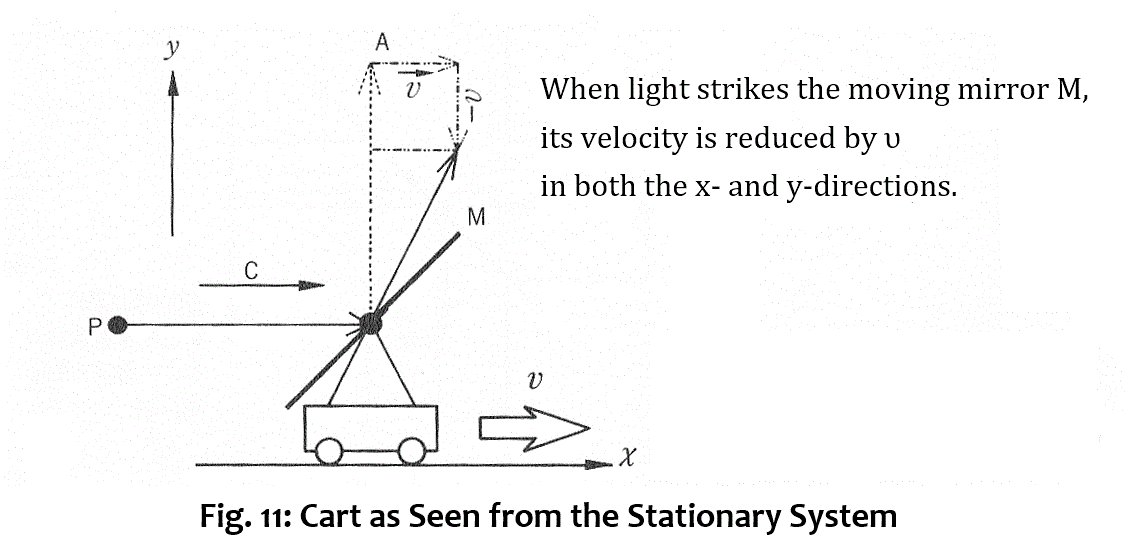
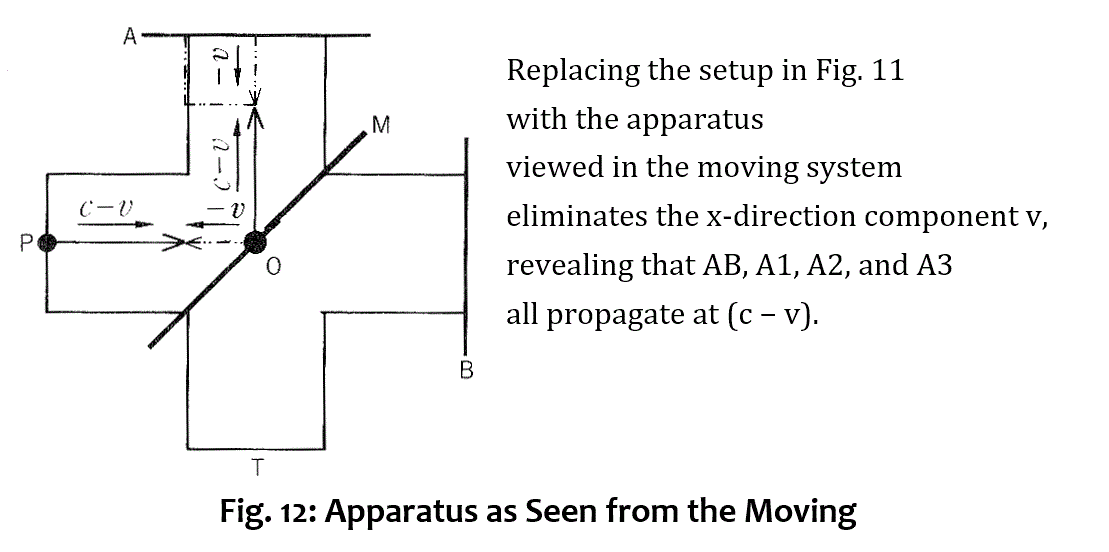
The only remaining segment is B3. From the moving system, B2 is (c − υ). To convert to the stationary system, we add υ. But since B2 had its sign reversed earlier, we restore it first:
(−c + υ) + υ = −c + 2υ
Reversing the direction again gives (c − 2υ). Because the light is moving opposite the motion, it appears slower.
Taking into account the 45‑degree mirror and the fact that it is moving toward the light at speed υ, we obtain Figure 13. Converting this to the moving system yields Figure 14. Ultimately, B3 also turns out to be (c − υ).
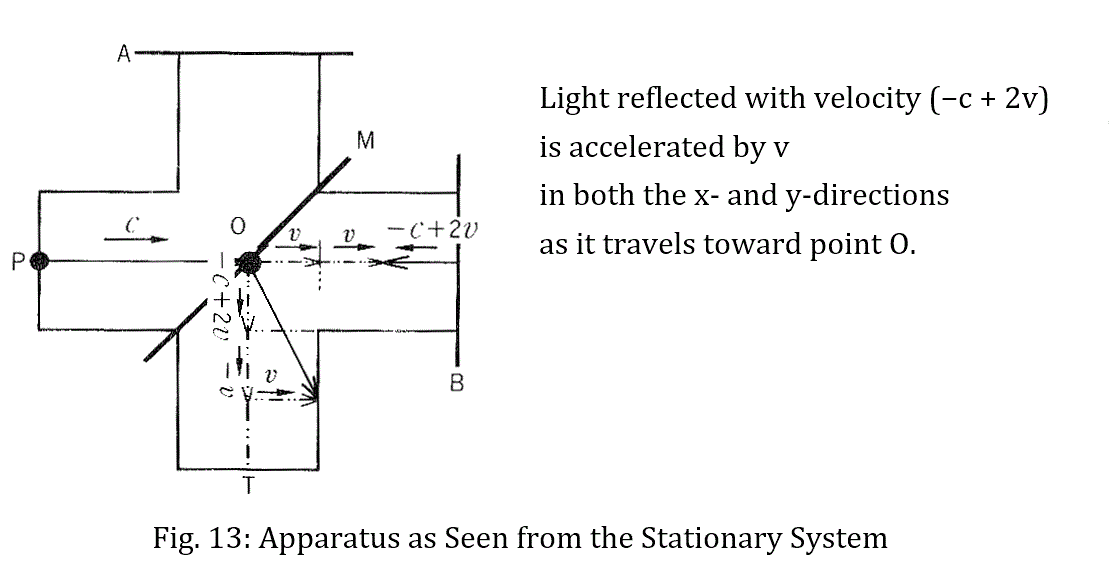
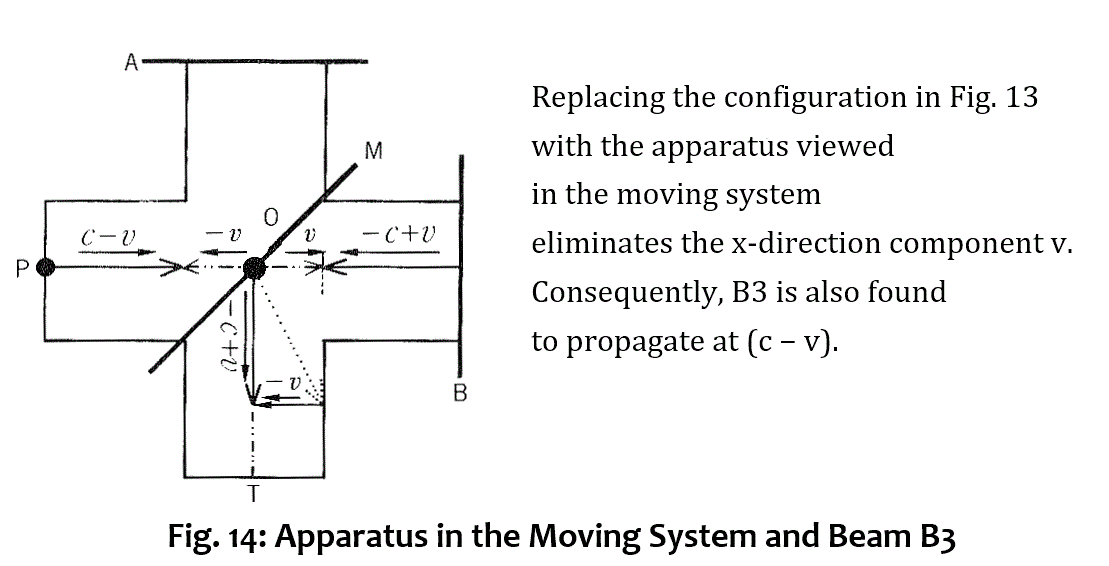
Since ∠POA′ and ∠BOT are right angles, the optical path lengths A and B are identical. All speeds were (c − υ). Therefore, beams A and B reach point T simultaneously, and no change in interference fringes is observed. Thus, the Michelson–Morley experiment can be fully explained using classical physics alone.
Alternatively, one could simply note that if AB has speed (c − υ) in the moving system, then by conservation of momentum, all segments must have speed (c − υ).
Can Commercialized Physics
Make a Courageous Retreat?
Just as modern physics once felt the need for the theory of relativity, the growing gap between theory and experiment today seems to demand a correct theory. As countless theories appear and disappear, abandoning classical physics too easily is unwise. Instead, searching within it for a “Silver Hammer” may be one of the fundamental ways to resolve the problem.
If tax money were being wasted on research to coax pigs into climbing trees, everyone would question it. In a massive pigsty built with enormous funding, researchers would earnestly continue flattering pigs every day, waiting for the moment one finally climbs a tree. After years of no results, they would say something like, “With more funding, we might discover a better way to flatter pigs.” Whether pigs can climb trees no longer matters. Even if someone tells them it is merely a proverb, they would continue.
While experts promote the correctness of the theory, those who maintain a fair perspective emphasize the importance of re‑examining a flawed theory. Even when told that relativity is not physics but a mathematical trick, the sight of distinguished scholars clinging to a theory that collapses in ten minutes is almost comical. Why do those who advocate relativity never attempt to verify the beginning of the theory?
This chapter has shown that anyone with a book on relativity can verify its errors using simple mathematics. Whether one chooses to “believe” in relativity or to “verify” it depends on personal ethics. What matters is that each individual checks carefully and does not swallow a flawed theory without question. Can modern, commercialized physics truly make a courageous retreat? The real answer to the genius’s puzzle seems to be hidden there.
I conclude this essay with the hope that the issue will be resolved as soon as possible.
